Tierra de Oro Laboratory

Physiology and Ecology in the Pinyon-Juniper Savanna

Author: Dave

  • Desert vs Jungle

    A little bit of physiology to start off the summer.

    We are gearing up to complete the data sets for local beetles this fall. Ultimately, we’ll be comparing metabolism of two Eleodes species, E. obscura and E. longicollis, with those of a few mimics, Philolithus elatus and Stenomorpha marginata. The data from last fall were very interesting, but after drafting the manuscript it was clear that another season of data would help to clarify the results.

    Because of seasonal availability, comparing Eleodes with their mimics will have to wait until late summer and early fall. Eleodes longicollis is common all summer, but E. obscura becomes much more common in July. Philolithus elatus and S. marginatus will not appear until the end of July at the earliest.

    In the meantime, there were a couple of other species available in the lab that will help in understanding the data from Eleodes, Philolithus, and Stenomorpha.

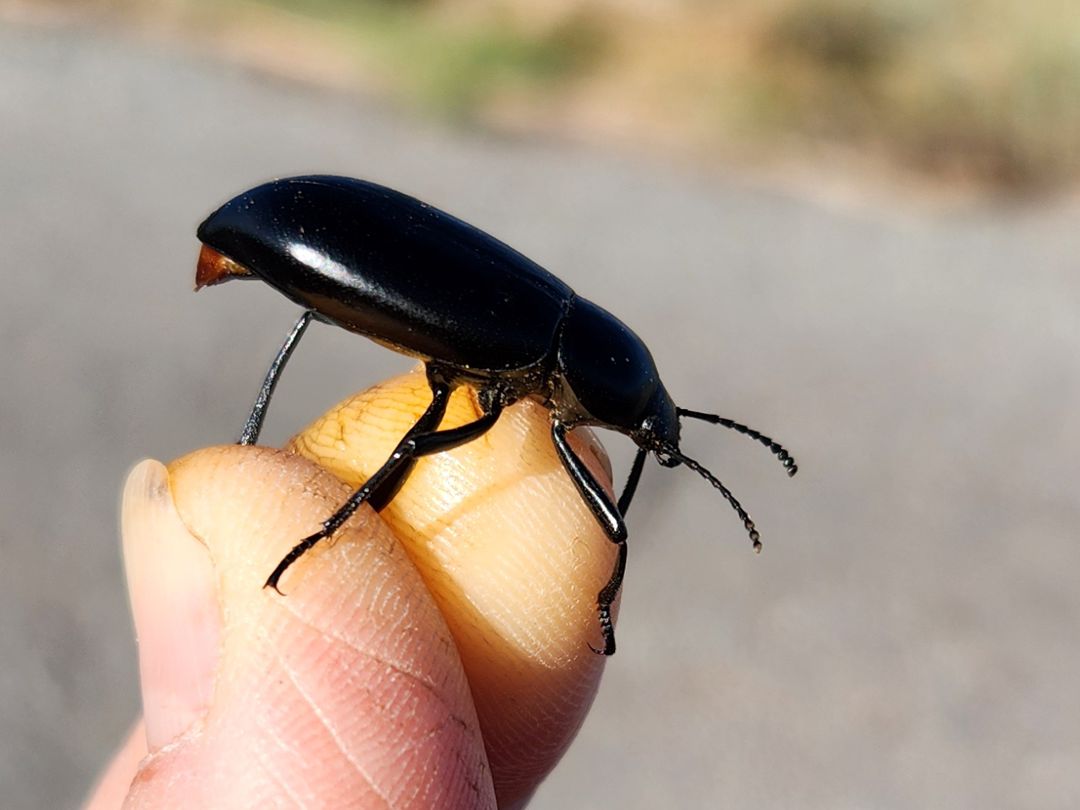
    Zophobas morio. Yellow paint on right elytra is for individual identification.

    Zophobas morio, also known as the “superworm,” is originally from the American tropics. It is widely cultured as a food for pets and is being considered as a source of protein for humans. A colony was established in the lab in early 2024, so they are available for experiments any time. Being from the neotropics, with consistently warm and relatively wet conditions, they are expected to respond more strongly to temperature changes.

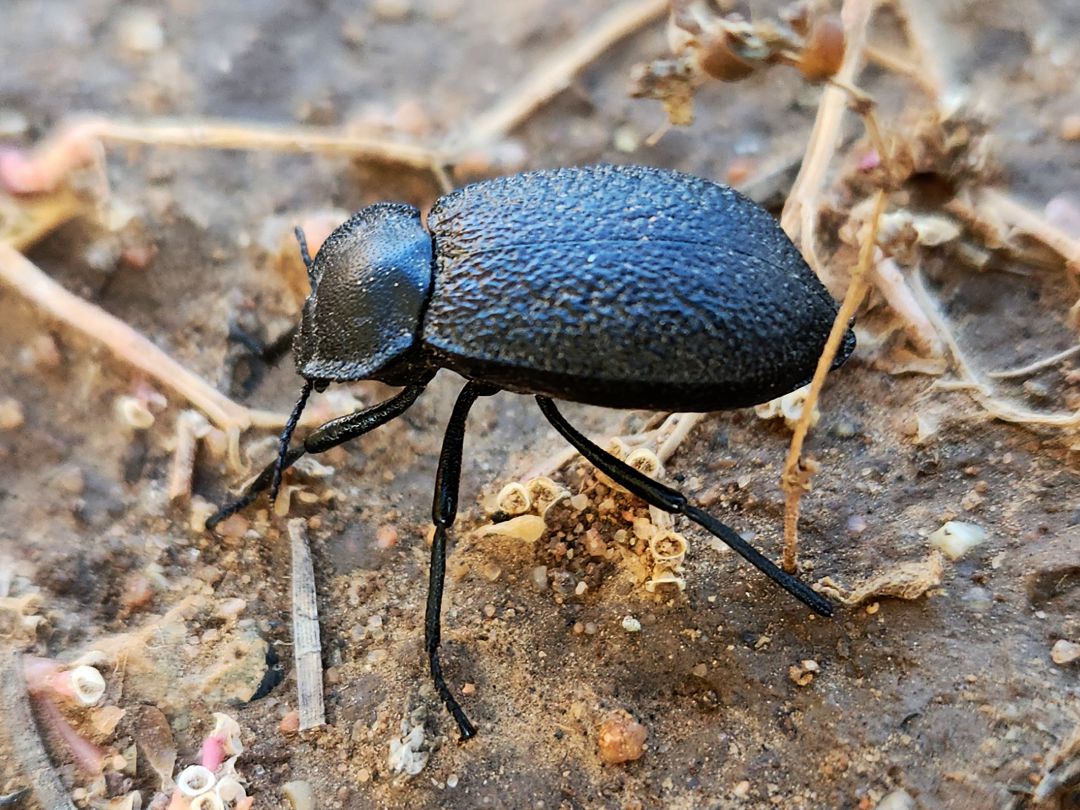
    Bluish-black beetle with rough thorax and elytra.
    Asbolus verrucosus, the blue death-feigning beetle.

    Asbolus verrucosus, called the blue death-feigning beetle because of its tendency to play dead when handled, is a long-lived species from the hot, dry deserts of southwestern North America. We received a cohort from Bugs in Cyberspace in January, and they have spent the past few months adjusting to handling and conditions in the lab. Their adaptations to extreme conditions suggest that they will be tolerant of high temperatures.

    Oxygen consumption was measured for the two species from 15°C, at which beetles should be slow and sluggish, to 40°C, just below the lethal temperature for a close relative of A. verrucosus (Cryptoglossa muricata; Ahearn, 1970). Therefore the temperature range may cause cold stress at at the low end and heat stress on the high end, but was not expected to be lethal.

    The two species are just about the same size and mass, with each being somewhat over half a gram. Twelve beetles of each species were tested at each temperature, although technical issues reduced this to eleven in a few cases. The respirometer could handle eight beetles at a time, so four of each species were tested together each day, and each temperature required three days of experiments.

    Oxygen consumption of Z. morio and A. verrucosus between 15°C and 40°C. Each point shows the mean and standard error of 11-12 beetles, with most error bars smaller than the symbols. At each temperature above 15°C, Z. morio consumed more O2 than A. verrucosus. At 40°C, all Z. morio were visibly impaired immediately after experiments, and 8/12 were dead within two days. None of the 12 A. verrucosus showed any signs of stress after 40C experiments, and all survived indefinitely (one week so far) after being returned to their enclosure.

    At 15°C, O2 consumption was identical for the two species. At every other temperature, Z. morio consumed significantly more O2 than A verrucosus. This may reflect a lower standard metabolic rate for the desert species, which is adapted to an environment with limited resources. Neither species showed any sign of stress at either 25°C or 35°C, in that both emerged from experiments active and coordinated, and none died in the three days between experiments.

    The two species diverged further at 40°C, with Z. morio dramatically increasing their O2 consumption (note the log10 scale), while O2 consumption in A. verrucosus increased only slightly. Importantly, all Z. morio were visibly impaired at the end of 40°C experiments, showing slow, uncoordinated movement or no movement at all. Eight of twelve Z. morio were dead within two days. In contrast, none of the A. verrucosus tested at 40°C appeared to be stressed, and all survived indefinitely.

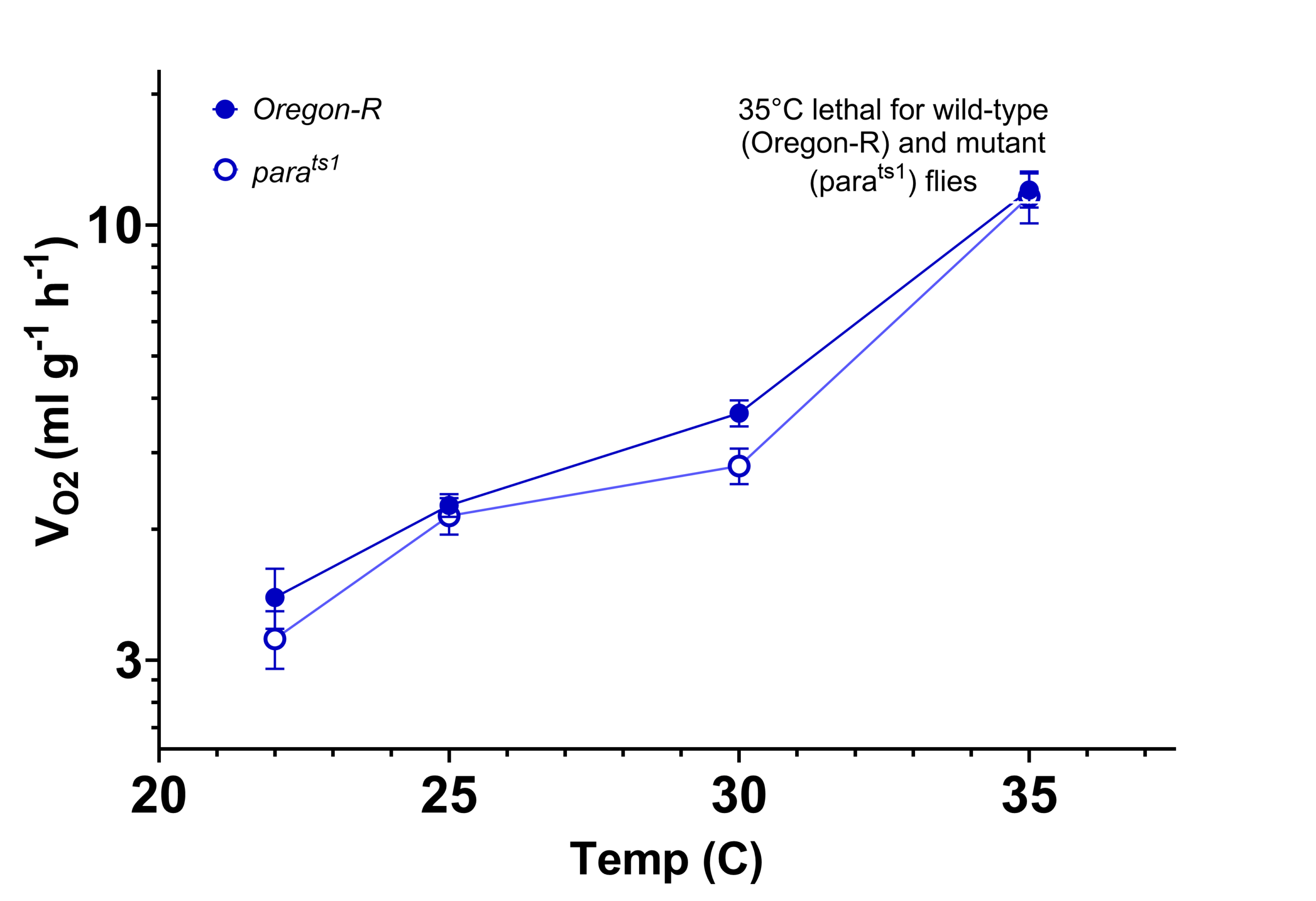
    It is perhaps not surprising that Z. morio, a species originating from a relatively constant, resource rich environment, has a higher metabolic rate and is more sensitive to environmental temperature than the desert beetle, A. verrucosus. The dramatic increase in O2 consumption and lethality between 35°C and 40°C for Z. morio was quite striking, however. The lethality-associated increase in metabolic rate resembles that in the fruit fly, Drosphila melanogaster at 35°C (Sandstrom et al., unpublished), and indicates that a dramatic increase in O2 consumption may be a common indicator of severe heat stress in insects.

    There are a few possible caveats. For example, although the two species have been kept under the same conditions for at least four months, which should be enough to reduce the effects of previous physiological adaptations, their life histories as larvae and pupae were different. Z. morio have been reared for multiple generations at the lab, while A. verrucosus were collected from the wild, which may somehow influence their responses to temperature. Asbolus and their relatives can be reared in captivity (Rider, 2024), so it may be worth repeating the experiment with lab-reared beetles.

    References

    Ahearn, G. A. (1970a). Changes in hemolymph properties accompanying heat death in the desert tenebrionid beetle Centrioptera muricata. Comparative Biochemistry and Physiology 33, 845–857.

    Rider, S (2024) Death Feigning Beetles of the United States and Mexico. Publisher S. Rider Jr. 182 pp.

  • Western Bluebirds: One Cycle Complete

    Although the screech owls have been hogging all the attention this spring, many more birds are raising families in the area. Spotted towhees, Bewick’s wrens, lesser goldfinches, and chipping sparrows can be observed singing their songs and collecting food for their offspring.

    We have been very lucky to have a clear view of a pair of western bluebirds. There has been a nest box on the back lot for many years. Last fall, it was time to replace the old, battered box with a new one, and the birds settled in early this spring.

    Female western bluebird on nest box. 3/11/25.

    They were getting things ready by the beginning of March.

    Bluebirds staking out their nest on a cold spring morning. 3/15/25.

    Despite the cold, they were ready to get started. Note the fluffed feathers in the photo above.

    Mom peeking out of the box. 4/25/25.

    The process was largely mysterious, with the parents coming and going during April and May, but no sightings of the nestlings.

    The babies finally started sticking their heads out in May. Mom and dad brought food on a regular basis/

    Nestling ready to test its wings and become independent. 5/23/25.

    By the last part of may, the kids were ready to see the world. Within a day of showing their heads, everyone was gone.

    Female starting the next nest. 5/29/25.

    I cleaned out the old nest a few days after the fledglings left, and was surprised to see a pair of bluebirds bringing new materials less than a week later. It is impossible to say whether these are the same parents, but it seems likely. They can often raise more than one clutch per year, so maybe we’ll see more fledglings in a few months.

  • Owl Cam: Maybe a Week To Go

    The owlets in the nest box have been growing at an astounding rate, and are well on their way to fledging. The parents have been delivering food constantly, and the chicks get more active and inquisitive all the time.

    Sleepy parent having a look out the doorway. Credit Terry Morgan, 5/10/25.

    The parents have been out and about quite a bit, and seem unbothered by the presence of observers and paparazzi.

    Parent, probably mom, resting in the late morning. 5/14/25.

    Family Album from Past Years

    This seems like a good time to reminisce about past broods. It’s hard to know how long these particular parents have been rearing young in Terry’s box, but screech owls have been nesting there for many years. Terry has many more excellent photos; here is a small sampling.

    Parent resting on a chair on the patio. Credit: Terry Morgan.
    Four fledglings and a parent (far right) in the eaves. Credit: Terry Morgan.
    Fledgling on the patio. Credit: Terry Morgan.
    Fledgling in a pinyon tree. Credit: Terry Morgan.

    The drama in the nest box continues. Based on past broods, he expects them to fledge on or about May 22. As always, stay tuned for more.

  • Amazing Fractals in Motion

    Here at the lab, we are interested in all sorts of scientific pursuits. At the intersection of art and mathematics, the generation of fractal images can produce some breathtaking results. Dr. Hans Ruppel has been using complex equations to generate beautiful fractal images for some time now. He has been using artificial intelligence to accelerate the process and and take his craft in amazing new directions.

    Below is one of his latest creations, which he has fine-tuned for scale and pacing. Enjoy!

    I am certain that the beetles would be mesmerized by it if they had better eyesight.

  • Owlets Have Hatched!

    As Terry predicted, the eggs started to hatch last night. So far three of the eggs have hatched, which is a local record for simultaneous emergence. This may be the result of the female owl having left the first eggs on their own during the early days.

    Three owlets sprawled on their siblings’ eggs. 4/22/25.

    At the moment, the owlets look like fuzzy blobs, but in the video you can see three sets of wiggly heads, bodies, and wings.

    Let’s hope for the other two to hatch successfully in the next few days.

  • Spring Is Here: Turkeys, Beetles, and Owls

    A little warmth brings out a lot of wildlife

    In the past week, temperatures have shifted upward dramatically. It’s above freezing every night, and plants and animals have responded appropriately. There is so much to see.

    We made a quick trip down to Bosque del Apache Wildlife Refuge near San Antonio, NM. The sandhill cranes are all gone, but there are plenty of ducks and songbirds. We stayed at a house near San Antonio, and were treated to a small group of wild turkeys. The females spent a lot of time foraging near the house, and a male would occasionally stop in and try to woo them.

    Male turkey doing his fancy dance and looking just like a Thanksgiving centerpiece. 4/11/25. The download speed may not be quite enough for perfect streaming, so you may want to re-run it for a smoother experience.

    There were also a few mammals, such as javelinas and coyotes.

    Javelina at Bosque del Apache North Loop. 4/10/25.

    We also came across an Eleodes, probably E. gracilis

    Eleodes gracilis.

    Back at the lab, spring is in full swing. Winter birds, like juncos and robins, have moved on, and summer residents, including lesser goldfinches and Say’s phoebes have settled in.

    Some of the year-round residents, such as western bluebirds (and, of course, screech owls) are taking their jobs as parents seriously.

    Male and female western bluebird staking out their new box. 3/15/25.

    As added enticement, we replaced the old bluebird box with a shiny new one.

    Stink beetles are very much making their presence known. One can now find multiple species of Eleodes on a casual stroll around the neighborhood.

    Eleodes caudifera found wandering the street. 4/13/25
    Eleodes hispilabris on trail near the lab.

    Now that the weather has warmed up, this month’s pitfall trap survey was a bit more interesting.

    There’s plenty of traffic through the field with the traps, including this big, fuzzy coyote that strolled through the week before the traps were set.

    Coyote casually wandering through the field with the traps. The rock behind its right rear foot marks one of the trap sites. 4/2/25.

    We caught a few Eleodes sponsa in the traps, along with wolf spiders, ants, and weevils.

    Eleodes sponsa after a few measurements i n the lab. 4/12/25.

    So the natural world has gone from quiet to extremely busy this month. Don’t forget to check out the updates on the owl cam page if you have a few minutes.

    Female owl snacking on some leftover mouse. 4/10/25.

  • New Feature: Species Pages

    In addition to its other functions, this site serves as a notebook for keeping track of data and references. In our effort to keep a handle on the local species’ characteristics and publications, information about each will be posted on its own page.

    Eleodes obscura, participating in notetaking. 9/20/23.

    The first species to receive this honor is the prominent, large, and widespread stink beetle, Eleodes obscura. It has been the subject of field surveys, respirometry experiments, and longevity studies here at the lab, and may be the most studied species of Eleodes.

    Expect more pages to become active with time. Hopefully, this will become a resource that many people in the community can make use of.

  • Owls Settling Down

    Terry’s owls are getting serious about the business of parenting. The female appears to have decided that five eggs are enough, and is incubating them full time. The male has been bringing her mice, and she has been dining in rather than leaving the box to eat them.

    Owls in the box. The male (right) has brought a mouse to feed the female while she incubates the eggs. The mouse is in her mouth at the bottom center of the image. 4/2/25.

    Five eggs will be a pretty good brood if they all hatch and survive. For the next few weeks, she will be tending them, with the first egg expected to hatch about April 22.

  • New Feature: Owl Cam

    New Season of an Ongoing Project

    For several years, our neighbor Terry has been recording and posting footage from his camera inside a next box occupied by a pair of western screech owls. He has always had a strong following on Facebook, but for those of us who do not use the platform, he has offered to make the information and videos available here on the Lab web site.

    Black and white image of an owl sitting inside a nest box
    Owl resting triumphantly after removing the mirror that had been mounted on the upper right. 3/4/25.

    Once again, they have prepped the nest box and have started to lay eggs. The first video clips have been uploaded to Terry’s Owl Cam page, along with his comments and a spreadsheet of data regarding previous broods.

    New videos and commentary will be uploaded regularly, so stay tuned for plenty of drama and excitement. There are two eggs now, with more to come, and then it will be about another month before they hatch. Once the eggs hatch, there will be a festival of cuteness as the little fuzzballs eat and grow for roughly another month before they fledge.

  • Life in the Frigid Wastes

    Arthropods Active in the Cold

    Field with small trees, bushes, and grasses, covered in a few inches of snow.
    Pitfall trap array after a night of snowfall. The blue flags marking the locations are visible, but the traps are difficult to find. 3/8/25.

    The pitfall traps were set this month with the expectation that it would be too cold for small arthropods to be active. The data would serve as a baseline for later surveys, when bugs would be more active. As if to emphasize this point, we got a few inches of snow the night before the traps were to be collected.

    Snow with some grass poking through and a blue flag in the middle.
    Pitfall trap under snow. It is somewhere near the flag. 3/8/25.

    Even though each trap was marked with a flag and had a big rock on top, some were hard to find under the snow, and I had to be careful to avoid spilling too much snow into the cups.

    When I got them back to the lab, I was in for a surprise.

    Ant with reddish head and thorax, brown abdomen, and long legs.
    Ant caught in pitfall trap. Species unknown, but not Pogonomyrmex. 3/8/25.

    The cups were not overflowing with life, but there was plenty to see. The most common insects were ants. About half (maybe 5) were the large, leggy species shown above. The rest were the much smaller species shown below. Sorry there’s no scale, but they were moving too quickly for that. I preserved some, so may post better photos later.

    Small ant species. 3/8/25.

    There were also quite a few springtails (Collembolans), probably of several species.

    Tiny insect with long antennae.
    Springtail caught in pitfall trap. 3/8/25.

    They are extremely tiny, and I know little about them, so all I can say at this point is that there were springtails active in the neighborhood.

    Brown spider with light markings on dusty background.
    Spider from pitfall trap. 3/8/25.

    There were also at least three spiders, of at least two species. According to iNaturalist, the spider shown above is a ground crab spider in the genus Xysticus.

    Most exciting were two species of beetles.

    Weevil on light background.
    Grey weevil with dark blotches, covered with coarse hair. 3/8/25.

    One weevil fell into a trap. It is about 6 mm from nose to tail. Looks somewhat like Ophryastes, but I am not certain.

    Hairy, reddish beetle larva next to a millimeter ruler.
    Beetle larva, probably in the family Melyridae. Note the relatively long thorax and the urogomphi (spiky things) extending from the end of the abdomen. Ruler scale is millimeters. 3/8/25.

    There were also two larvae that looked like they were in the family Melyridae, or soft-winged flower beetles. They looked identical to each other, so maybe they are relatively common around here. The larval biology of most beetles, including the Melyridae, is not well documented, so it may be impossible to determine the species of these guys.

    It was a pleasant surprise to find some little arthropods in the traps this month, especially a few species of beetles.

    There were, however, no Tenebrionids as yet. In that way, this month’s collection does actually serve as a control. I expect that we may find some of them when the traps are reset in early April.