Here at the lab, we are are lucky to have a close up view of nature. It’s a constant parade, with beetles emerging from their winter homes, ants swarming to start new colonies, winter birds leaving, summer birds arriving, and much more.
Carpenter ants swarming. A major worker (front left) guards the nest entrance while a winged male gets ready for his brief duty of finding a mate. 5/9/26
Four of five of the eggs in Terry’s nest box have hatched, and the owlets are growing rapidly. Of course, for each meal the owlets enjoy, a mouse, bird, or insect has a very bad day.
Dead mouse being delivered to growing owlets. 5/726
Snake in a Box
We have been tempted to add another bluebird box that has a camera so that we can watch the process of growth and fledging. I have been hesitating, largely because some broods do not survive and I am not sure that I want to watch that happen. My attitude was reinforced this week, when the female bluebird did not go into the nest box, and there was a something strange and pink sticking out of the hole.
When I opened the box, there was a large pink coachwhip snake inside. It had made a meal of the brood, even though the nest is on a pole about four feet off the ground.
Large coachwhip occupying bluebird box, having consumed most recent brood. 5/10/26
Looks like it will be necessary to add some flashing around the pole to make it harder for snakes to reach the box.
Lame Coyote
There seems to be a large crop of rabbits this year, which has led to plenty of coyote sightings. I see them at least a few times a week on morning surveys, and they show up regularly on the wildlife cams.
Terry was lucky enough to spot one finishing its rabbit meal, and fast enough to get a video. Another coyote, with an injured front leg, tries to share, but the first coyote is having none of it.
Coyote having breakfast, courtesy of Terry Morgan. 5/9/26
It is a harsh life out there, and a coyote that can’t hunt will not be able to eat. Animals can heal, so it may be back on all four feet and able to hunt again.
Four of the five eggs have hatched, and the parents are feeding them heavily with insects, rodents, and birds. The most recent videos are here. For all the rest, check out the owl box main page.
As mentioned in an earlier post, the beetle ecology/physiology project has split into two separate sets of experiments. For the ecology project, I am hoping to get some good data regarding beetle abundance, seasonality and predation, but that will be the subject of other posts.
To get a more mechanistic understanding of heat stress in the beetles, I plan to do two sets of experiments once the beetles are available later in the summer. One will be a relatively straightforward measure of the range of temperature tolerance for the stink beetles (Amphidorini) and their non-stinky mimics (Asidini).
The other experiment will measure activity in the nervous systems of the beetles when they are under heat stress. There is considerable evidence that there is a blast of neural activity, sometimes referred to as a “spreading depolarization” when insects enter a state of paralysis known as heat coma. I would like the measure the temperature that is required for the spreading depolarization in the Amphidorini, which are relatively heat sensitive, and the Asidini, which are more resistant. The hypothesis is that it will take a higher temperature to induce spreading depolarization in the Asidini.
To get those data, I will need an amplifier to record neural activity in the beetles. Although I could spend a few thousand dollars on a new, ready made amplifier, there are some nice DIY designs in the literature. The circuit I chose (from Land et al., 2001, J. Neurosci Meth. 106:47) should do everything I need. It can amplify signals between 100X and 1000X, it has filters to stabilize the signal and reduce noise, and is relatively inexpensive to build.
The circuit diagram from the original paper is shown above. It uses two op-amps for amplification and filtering, and was designed to be powered by two 9V batteries. I will use the same circuit, but plan to use a 9V DC power supply for simplicity.
Most of the components arrived from Mouser Electronics today, and I can get started once a few more things (like the circuit boards) arrive. I plan to build one single channel amplifier to work out the process (little box on top), then assemble a four channel unit to record multiple beetles at once (bottom box).
The middle box will house the analog-to-digital converter (ADC), which will allow me to record the data on a computer.
I will post more details about the setup and procedures as things progress.
Special thanks to Dr. Hans Ruppel, whose support is making this project possible.
The western screech owls in Terry’s nest box are starting their spring activity. They seem to be slower getting started than in previous years. Nonetheless, there is nesting material in the box, and the male is hunting for food. Hoping for eggs soon!
If you want to see all the videos, including those from last year, go here.
After working very hard this winter to submit a manuscript describing the most recent results of the project, I realized that it has really become two non-overlapping lines of inquiry.
A few weeks ago, I submitted a manuscript titled “Batesian Mimicry and Thermal Resilience Among Tenebrionid Beetles from a New Mexican Piñon-Juniper Savanna” to the Journal of Experimental Biology. The editor said some kind words about it, but ultimately rejected it because it did not fit comfortably into the aims of the journal. The main complaint was that a significant portion of the paper focused on the ecology of the beetles, rather than their physiology.
It took a few days for me to realize that the paper had evolved into something different. Looking over the title, two things may stand out.
Batesian Mimicry
Thermal Resilience
Those are really two separate concepts and analyzing either one can be performed relatively independently of the other. In other words, this was two incomplete papers rather than one solid story.
Now begins the process of completing both of those stories.
Mimicry
Several lines of evidence address whether the Asidini Philolithus elatus and Stenomorpha rimata are Batesian mimics of the Amphidorine Eleodes obscura. For an organism to be a bona fide Batesian mimic it must
Resemble the model in the eyes (or ears or nose) of potential predators.
Be palatable
Be undefended (or at least to a potential predator)
Overlap the model in space and/or time so that predators can learn the association
Be relatively uncommon to prevent predators from discovering their mimicry
The Asidini fulfill these criteria to varying degrees
The major argument for mimicry is that the Asidini look a lot like E. obscura, and are about the same size and mass.
A close relative of S. rimata, S. marginata, has been shown to be palatable to mice and skunks. Palatability of P. elatus is unknown.
On the minus side:
P. elatus will regurgitate when handled, suggesting at least mild defense
Headstanding behavior, which contributes to the mimicry, is weak (P. elatus) or non-existent (S. rimata)
Both Asidini are at least as common as E. obscura during peak season, giving predators plenty of opportunity to learn that they are quite edible.
Stenomorpha rimata is present in late September and October, when Eleodes have disappeared from the surface, giving predators plenty of time to learn that they are tasty and undefended.
I really need to know who the local predators are, so that I can make sense of all this. I hope to use the upcoming field season to find out who is eating beetles around here. Based on scats and scattered body parts, someone is eating them, but who?
Thermal Resilience
Maintenance of scent glands is costly, so E. obscura should either use more metabolic energy than the undefended P. elatus and S. rimata, or devote less energy to other aspects of fitness. Based on respirometry across a range of temperatures it would appear that all three species use the same amount of energy per unit time, but the Asidini have much higher survival at elevated temperatures.
This is a nice partial story, but I need to know more about possible mechanisms. Two sets of experiments would be very helpful in completing this part of the story.
Testing survival across a full range of temperatures. I have only tested up to 40C, which is semi-lethal to Eleodes but does not strongly affect P. elatus or S. rimata. Although I am no fond of the idea, I need to test up to a temperature that is 100% lethal in order to have a complete picture of thermal resilience.
Because temperature induced lethality is associated with disrupted ionic regulation, it will be important to examine concentrations of ions in the hemolymph (blood) of E. obscura, P. elatus and S. rimata at high temperatures.
If all goes well, I should have two papers ready by the end of the season. Wish me luck.
Many of the darkling beetles here are members of model/mimic complexes. Specifically, some species of Eleodes, which can defend themselves chemically by using scent glands in their abdomens, serve as models for members of other genera, such as Philolithus and Stenomorpha, which do not have glands (Brown, 1971; Smith et al., 2015). In theory, the mimics are protected from predators by resembling the defended beetles, but save energy by not having to grow, maintain, and fill the glands. When a mimic resembles a defended species but does not have its own defense, it is referred to as Batesian mimicry.
As we look over the data from the past few seasons, it is worth considering some of the assumptions regarding models and mimics.
Advertising Bad Taste
Let’s start with the models, the chemically-defended Eleodes. If a species is noxious in some way, advertising this fact benefits both the prey and predator. If the predator knows that the prey is inedible, then the prey will avoid being eaten, and the predator avoids a mouthful of something nasty. Many noxious prey have bright, contrasting colors to make it easier to recognize them.
There are about six species of Eleodes commonly found here, and all have similar appearance and behavior. They are black, generally shiny, about 15 to 30 mm long (depending on the species), with variations in their body shapes and the patterning of the thorax and elytra (for an overview, see the local beetles page).
Eleodes obscura traveling across an open field. 7/9/25.
One could argue that uniformly black beetles are not very striking, and may therefore be doing a poor job of advertising their distastefulness. However, when walking about, they put little effort into concealing themselves, and a shiny black beetle is pretty easy to see on a background composed of shades of brown and drab green. Further, when approached the beetles stand on their heads to aim (and presumably show off) their scent glands.
Eleodes obscura reacting to an approaching threat by standing on its head. 8/17/24
These guys may not be as flamboyant as a coral snake or a lionfish, but they get the point across. After a few tries, a predator will probably get the idea that attacking one of these beetles will result in a face full of noxious chemicals.
The Mimics
From April to late July, the area is inhabited mostly by “honest” beetles, whose appearance and behavior truly reflect their ability to defend themselves. Starting in late summer/early fall, a group of “cheaters,” or mimics, starts to emerge. These are beetles that are about the same size and appearance as Eleodes, and in some cases act like them, but do not have defensive glands.
Eleodes obscura dispersa and Philolithus elatus infernus at the same scale. The elytra show similar patterns of ridges and punctures. Paint spots mark them for physiological studies.
One species, Philolithus elatus, is considered to be an accurate mimic of E. obscura. Both E. obscura and P. elatus have multiple geographic subspecies, and the patterning on the elytra of each P. elatus subspecies resembles that of the E. obscura subspecies that shares its range (Brown, 1971). In the example above, the elytra of P. elatus infernus found in Santa Fe have weakly defined ridges, similar to those of the local E. obscura dispersa.
Philolithus emerges in late July and is abundant through August and early September. This means that predators have had since the beginning of April to sample Eleodes and learn that shiny black beetles taste bad. Another supposed mimic of E. obscura, Stenomorpha marginata, emerges even later, in late August and is present in September and October.
Stenomorpha marginata. 9/3/25.
At first glance, the mimics could easily be mistaken for E. obscura, and a predator might pass them by. At other loacations, it is reported that both species even mimic the headstanding behavior of Eleodes (Brown, 1971; Smith et al, 2015). Here in Santa Fe, it takes physical contact (rather than a close approach) to get P. elatus to respond, and even that is half-hearted.
Philolithus elatus giving its best effort at a headstand.
Stenomorpha marginata bracing for whatever comes next. 10/1/25.
Stenomorpha does not even bother with a lame attempt, and just extends its legs outward to brace itself when touched.
Another mimic produces more convincing headstands. Moneilema appressum, the cactus longhorn beetle, is a member of a completely separate family of beetles (Cerambycidae). Nonetheless, its smooth, shiny appearance and willingness to stand on its head when approached make it a convincing mimic of Eleodes longicollis.
Eleodes longicollis raising its abdomen in response to an approaching experimenter.
Moneilema appressum performing a convincing headstand. 8/20/25.
All of this leaves a few open questions.
First, how good does mimicry really have to be? From April to August, just about every shiny black beetle that a predator encounters is chemically defended. Do Philolithus and Stenomorpha need to imitate the appearance and behavior of Eleodes all that precisely, or is it enough to be a shiny black beetle of about the right size and shape? Based on scat found around here, someone is definitely eating Eleodes, so it’s likely that some mimics will get eaten anyway.
The fact that Moneilema seems to do a better job of looking and acting like an Eleodes species is intriguing, although I am not sure what to conclude at the moment.
Philolithus elatus regurgitating in response to handling. 8/11/25.
Second, are the mimics truly undefended? Philolithus will regurgitate when handled roughly, which, at least for grasshoppers, qualifies as chemical defense. Further, they feed, oviposit, and their larvae probably live among harvester ants (Pogonomyrmex sp.) during their development (McIntyre, 1999; Slobodkovich, 1979). It seems plausible that the beetles acquire some sort of chemical signature from the ants that deters attacks by the ants and other predators.
Stenomorpha, on the other hand, appears completely undefended. I have not observed them to regurgitate, they do not appear to associate with ants, and they do not have scent glands. They may be less vulnerable because they emerge so late in the season, but we will need to know more about their predators to have any insight into this.
References
Brown, K. W. (1971). A population approach to computer taxonomy with applications in the genus Gonasida.
McIntyre, N. E. (1999). Use of Pogonomyrmex nest-sites by Tenebrionid beetles (Coleoptera: Tenebrionidae) for oviposition and thermoregulation in a temperate grassland. The Southwestern Naturalist44, 379–382.
Slobodchikoff, C. N. (1979). Utilization of Harvester Ant Debris by Tenebrionid Beetles. Environmental Entomology8, 770–772.
Smith, A. D., Wilson, J. S. and Cognato, A. I. (2015). The evolution of Batesian mimicry within the North American Asidini (Coleoptera: Tenebrionidae). Cladistics31, 441–454.
Because it took so long to load when they were all on the same page, I have moved the owlet videos to new a series of pages. It’s slightly more hassle if you want to see all of them at one sitting, but it beats waiting what seems like forever for the pages to load. If you love it or hate it, use the contact link to send feedback.
More owl feedings. We are in the waiting period before the eggs hatch. The female sits on the eggs continuously except for short breaks. The male brings her mice and occasionally insects. Here are a couple clips of food deliveries.
In the first one, you can get an idea of how long their legs are as she stands up to peer out the hole before he arrives with a kangaroo mouse
In another clip, she is away when he pops in with a Jerusalem cricket (“potato bug”).
And a clip where she swallows most of a mouse that was leftovers.
4/22/25: We Must Be Getting Close!
No owlet hatching yet, hopefully tonight to still meet my prediction.
In the meantime, here are two clips of mice deliveries: a kangaroo mouse and a field mouse from a few days earlier.
Field mouse delivery. 4/19/25.Kangaroo mouse. 4/21/25.
The female has been spending all her time on the eggs and the last morning she has been fussing with them almost continuously and skipped her usual pre-dawn break. Maybe sensing the movement of the chicks inside?
Last fall, we gathered data on the physiology, temperature sensitivity and lifespans of Eleodes obscura and its presumed mimic Philolithus elatus. The data were interesting and I have drafted a paper, but it seemed worth trying to replicate the results to be sure the data were solid.
One of the limitations of working with a seasonal organism, like P. elatus, is that one can only work during a narrow window, when the animals are available and alive. True stink beetles, like E. obscura, survive for years, so one can simply collect a bunch and then do experiments almost indefinitely. Philolithus die less than two months after emerging, then are completely gone until late the next summer.
Hence my excitement at finding the first P. elatus of the season.
The first Philolithus elatus collected in 2025. 7/27/25.
More are emerging every day. We now have seven P. elatus available for experiments, and are hoping to bring the total to twenty within the next week. There are plenty of E. obscura available as well. We should soon have a big pile of data to add to the manuscript.
For a little more info on P. elatus, check out the new Wikipedia page that I started.
The islands in the Gulf of California provide a natural laboratory for the effects of “spatial subsidy,” the movement of resources from a rich environment (the sea) to a more impoverished habitat (the desert islands). In this context, scientists have studied many species on the islands, including Tenebrionid beetles. The abundance and diversity of beetles on the islands of Bahia de los Angeles have been surveyed for at least 30 years, and my good friend and colleague Dr Drew Talley has been leading the studies for most of that time. In recent years, Dr Natalia Rodriguez Revelo, an expert in beetles and dune ecology, has participated in the work with Drew. I have participated in various roles for several of the past 20 field seasons, and was once again privileged to spend time with them and help out on the islands this year.
Drew and Natalia counting beetles on La Ventana. 6/28/25.
The procedure is straightforward in principle: on each island, set multiple pitfall traps (plastic party cups) baited with lean pieces of fish. The beetles (and, occasionally, other creatures) fall into the traps. Six days later, the traps are checked and the number and species of beetles are scored. In practice, mice or gulls can steal bait if it is not adequately secured, or fat from fish guts can turn the contents of the cup to smelly soup.
In a perfect world, traps would be set on all of the accessible islands in the bay. In practice, time constraints forced us to prioritize. This year, we sampled Coronadito, Coronado (also known as Isla Smith), Flecha, Pata, Llave, Cerraja, La Ventana, Cabeza de Caballo, and Gemelos West.
I made an effort this year to photograph each species using a platform with tacky wax to secure the beetle, and a scale to document its size.
Map of the bay at Bahia de los Angeles. Most islands, including all islands sampled this year, are labeled. The town of Bahia de los Angeles is labeled at lower left.
It was marginally successful, and provided insight about how to improve future versions.
Below is a draft guide to the beetles found on the islands, When possible, photos are provided of beetles held in fingers and mounted on the photography platform. Cartoons provide graphic representation of the relative sizes of the beetles, ranging from tiny (Batuliodes) to hefty (Cryptoglossa), keeping in mind that the sizes of all species can vary significantly.
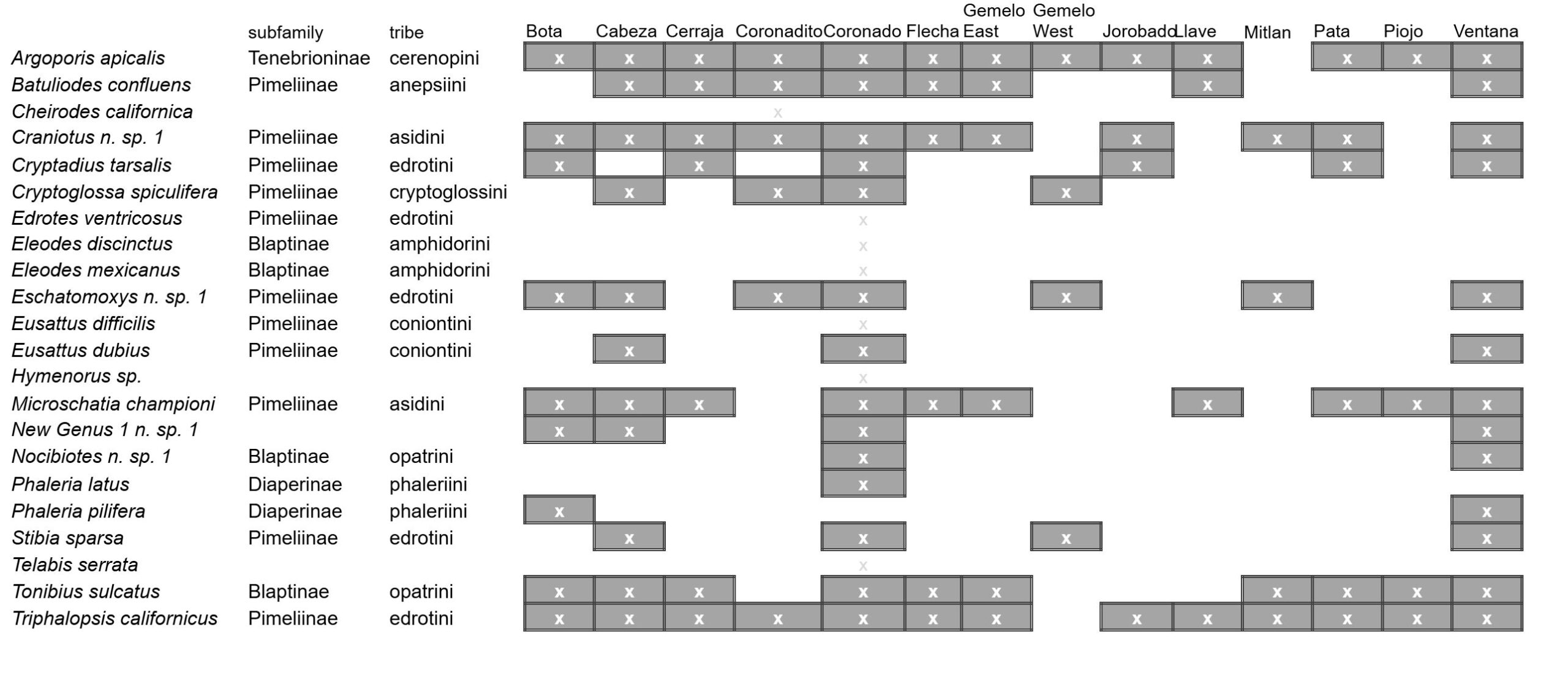
Distribution of each species are based on data from Sanchez Piñero and Aalbu (2002). A table extracted from their observations can be found here.
Click the photographs if you want to see larger versions.
Argoporis apicalis
Medium sized, with ridged elytra and reddish legs. Argoporis is one of the few Tenebrionids on the islands which possess defensive glands in their abdomens.
Found on all islands except Mitlan (tiny island next to Coronado).
12 mm
Argoporis apicalis trapped on Coronadito island. 6/26/25.
Argoporis apicalis trapped on Cerraja island. The blurred image of an extra antenna was caused by using focus stacking to improve depth of field. 6/27/25.
Batuliodes confluens
This tiny brown beetle with roughened pronotum and elytra.
Found on the majority of islands, and may be undercounted due to its small size.
~3 mm
Batuliodes confluens trapped on Flecha island. 6/23/14
Batuliodes confluens trapped on Cerraja island. 6/27/25.
Cryptadius tarsalis
Small, oval, and deep-bodied, with dense rows of small punctures on the elytra.
Cryptadius is found on Bota, Cerraja, Coronado, Jorobado, Mitlan and Pata.
8 mm
Cryptadius tarsalis.trapped on Llave island. Scale bar, 2 mm. 6/27/25
Cryptoglossa spiculifera
One of the largest beetles on the islands, with elytra decorated with rows of raised, spiny bumps.
Found on the largest islands (Coronado, Cabeza de Caballo, but not La Ventana) as well as the rookery island, Gemelos West.
28 mm
Cryptoglossa spiculifera trapped on Gemelos West island, 6/28/25.
Cryptoglossa spiculifera trapped on Gemelos West island. Scale bar, 10 mm. 6/28/25.
Microschatia championi
Slightly smaller than Cryptoglossa, the elytra of Micoschatia are decorated with dimples rather than sharp bumps and there are punctures on the lateral pronotum of M. championi.
Present on all but the smallest islands.
20 mm
Microschatia championi trapped on Cerraja island. 6/27/25.
Microschatia championi trapped on Cerraja island. Scale bar, 5 mm. 6/27/25.
Stibia sparsa
Shaped like a typical Tenebrionid, with dense punctures on the pronotum and rows of punctures on the elytra.
Stibia can be found on the largest islands (Cabeza de Caballo, Coronado, La Ventana) plus Gemelos West.
11 mm
Stibia sparsa trapped on Gemelos West island. 6/28/25
Stibia sparsa trapped on Gemelos West island. Scale bar, 2 mm. 6/28/25.
Tonibius sulcatus
Very small and reddish, with relatively smooth pronotum and strongly ridged elytra.
Described from most islands, except Coronaditio, Gemelos West, Jorobado and Llave.
6 mm
Tonibius sulcatus found at Las Hamacas hotel. 7/10/24.
Triphalopsis californicus
Small, black, oval, and deep-bodied. Covered with fine hairs that are often coated in dust.
Triphalopsis has been described from all islands except Gemelo West.
8 mm
Triphalopsis californicus trapped on Flecha island. 6/27/25.
Triphalopsis californicus trapped on Cerraja island. Scale bar, 2 mm. 6/27/25.
There are many other beetles, including various species of Histeridae and Dermestidae (not shown).
Hister Beetle on Coronadito Island. Scale 2 mm. 6/26/25.
Centipedes, spiders, and scorpions are often found in the traps in the larger islands.
Scorpion trapped on La Ventana. 6/28/25
References
Sanchez Piñero, F. and Aalbu, R. L. (2002). Tenebrionid Beetles (Appendix 6.1). In A New Island Biogeography of the Sea of Cortés, pp. 129–153. New York: Oxford University Press.