Tierra de Oro Laboratory

Physiology and Ecology in the Pinyon-Juniper Savanna

Tag: Tenebrionid

  • Spiders, Bats, and Mystery Poop

    Who has been eating our beetles?

    Mimicry is in the eyes of the predator

    Some beetles that do not produce defensive stink are thought to be mimics of those that do. For example, Eleodes species can shoot streams of noxious chemicals when threatened, whereas Philolithus and Stenomorpha, which have very similar size and appearance, do not. In this way, the non-stinky beetles may be protected from predators who have learned their lessons during previous meetings with Eleodes. This form of mimicry was first proposed about 150 years ago by Henry Bates, and is referred to as Batesian mimicry.

    Because we humans perceive the world largely through our eyes, we tend to think of mimicry in terms of visual appearance. The examples shown in textbooks (see below) tend to be butterflies or snakes with matching colorful patterns. These are expected to be especially effective against birds or monkeys that have excellent color vision.

    Harmless scarlet kingsnake, a Batesian mimic of the coral snake. Credit: Glenn Bartolotti , CC BY-SA 3.0,

    A close look at the snakes above will show that they are relatively easy to distinguish in photographs. Mimicry does not need to be perfect, because a mistake in the field could cost an unwary predator or hiker their life. As a human, you could memorize a rhyme that allows you to distinguish them, or you could simply avoid bright red, black, and yellow snakes.

    What about the beetle mimics? Should we think about vision, or other senses? If a predator has poor vision or hunts in the dark, then what is the purpose of visual similarity?

    Who Eats Local Beetles?

    One of my goals for the 2026 field season was to find out who actually eats the beetles. Each of the beetles shown at the top of the page would yield 1/2 to 1 gram of water, protein, and fat, so it is worth some effort to subdue the defended ones, figure out who is undefended, or both.

    Previous work by a number of authors has shown that large darkling beetles are consumed by a wide variety of predators. Depending on the location and beetle species, predators include mice, skunks, coyotes, bats, ringtails, jays, scorpions, and there are likely to be more.

    Below is a summary of what I have figured out so far. As always, there is more to come, but the evidence for the ones shown below is quite solid.

    Waiting in Ambush: Black Widow

    When I came across some beetles wrapped up in sloppy webbing, I was not sure who had killed them. After collecting the beetles and moving the prickly pear pad below them, I saw a large spider with a red spot on its abdomen in a hole below. Then it all made sense. Black widows spin notoriously messy webs, and are perfect predators of any large beetle that comes by. When caught in the web, Eleodes‘ defensive chemicals will be sprayed ineffectually until they are used up, and the spider can then immobilize and consume the beetle at her leisure.

    This spider also trapped an Embaphion contusum (also chemically defended) and a large scarab beetle. One would expect that undefended Tenebrionid beetles, such as Philolithus and Stenomorpha, would easily fall prey to such a spider. Her web is not selective, and she is able to subdue E. obscura, one of the largest and best-defended beetles.

    Chomped by Bats

    Pallid bats are known to eat Stenomorpha, and the resident group has dropped bits and pieces of large insects such as Jerusalem crickets and beetles. For more about the bats themselves, have a look at this post.

    In August, one of the bats was particularly messy, leaving most of the front half of a small Stenomorpha, possibly S. obovata.

    Now that fall is upon us, Stenomorpha rimata has become the most common Tenebrionid in the neighborhood. I was lucky enough to find some half-eaten, but readily identifiable bits of S. rimata under the roost last week.

    At this point, we don’t know if the bats are focusing on undefended beetles, or whether they would eat Eleodes if given the chance. It is clear, however, that pallid bats are willing and able to eat large Tenebrionid beetles such as Stenomorpha.

    Work in Progress: Beetles in Scat

    During the summer and fall, one can readily find scat containing beetle remains. Predators often swallow them whole, making identification much easier.

    Analysis is in the early stages, but there is lots to find. The photo above shows some of the head capsules that were in one scat. There were many Carabid beetles of a range of sizes, plenty of big and small ants, and a few good-sized Tenebrionids. Based on an abdomen that was also in the collection, at least one of the Tenebrionids was Eleodes obscura.

    There is much more to find, but we can say for sure that somebody, probably a mammal, is eating a lot of beetles. Importantly, they are including Eleodes in their diets. With persistence and luck, we should be able to figure out who it is as we dig deeper into the samples.

    The predators we have identified so far, spiders and bats, are not visual predators, so the outward resemblance of the mimics to Eleodes is probably not that useful. Moreover, it looks like at least some predators are happy to eat Eleodes, further reducing the possible benefit of mimicry. Nonetheless, we may find that birds such as jays and ravens are hunting the beetles, and we may yet identify some selective advantage to the visual resemblance shown by the mimics.

  • Bahia de los Angeles 2026

    It was a successful year for science and wildlife.

    Peninsular landscape on the trip down. 6/17/26

    Once again, I joined Dr. Drew Talley and Dra. Dr Natalia Rodriguez Revelo for a summer survey of the islands in Bahia de los Angeles, Baja California.

    Natalia and Drew on Jorobado. 6/19/26

    The work on the islands went well, and we got data regarding beetle populations from twelve islands. It is also a highlight of my year to spend the time with my best friend and our wonderful colleague.

    Although work on the islands can be challenging, we are usually done by late morning, and there is time for other activities. This year, I thought it would be interesting to test the thermal resilience of some of the beetle species. The specific idea is that beetles that produce defensive chemicals (like Eleodes does) would be more sensitive to extreme conditions such as high temperature when compared with undefended beetles (such as Philolithus in Santa Fe or Cryptoglossa in Bahia). This has been assumed to be the case, but has not been tested rigorously.

    My idea was simple: collect beetles from two species, one defended and one undefended, and test their survival at temperatures ranging from benign to lethal. My prediction would be that the undefended beetles would survive at higher temperatures than those that invest energy and water in defensive scent glands.

    We decided it was better to collect the experimental beetles on the mainland. The project was added to the permit application along with the other, ongoing projects. However, the permit only allowed us to survey the beetles on the mainland, not collect or test them. Nonetheless, sampling would allow us to determine where it would be best to find enough beetles for experiments in the future.

    Bahia de los Angeles dump. 6/18/26

    For our first sampling location, we set traps at the local dump. We reasoned that we could avoid protected areas and private property by sampling at the dump.

    We set nine pitfall traps, baited with oatmeal along an arroyo. After checking back every afternoon for three days, we had caught six Cryptoglossa muricata. It was good to find beetles that would be appropriate for experiments, but we needed at least two species, and about 40 of each. We thought it best to look elsewhere.

    One can see why beetles in the Cryptoglossini are called “death feigning beetles.” This C. muricata is quite alive, but waiting for me to go away. 6/20/26

    We thought that the Glendale Community College field station might be a better location, so we asked Jared Ocampo, an old friend and the station manager, for permission to set traps around the station. He agreed, and even helped us set the traps.

    Arroyo on the southern approach to the Glendale Station. 6/24/26

    We set a total of 24 traps in three sets of eight. One group was set in an arroyo to the south of the station, one set was placed in desert to the west, and the last was placed near the beach to the north. Rather than checking every day, we left the traps for two nights.

    The results were pleasing. We trapped more than sixty C. muricata, and ten Eleodes loretensis, along with a number of Stibia. This is an almost ideal result, in that E. loretensis is chemically defended, whereas C. muricata is not, and they are well-matched n terms of size and mass.

    The traps in the arroyo were the most productive, and those in the desert also caught a good number of beetles. Interestingly, those by the beach only trapped a few Cryptoglossa.

    Assuming that all goes equally well next year and we have the proper permit, we should be able to compare the temperature sensitivities of these two species that are highly similar except for the presence of chemical defense.

    As always, there is more to come.

  • Baja California: Annual Island Survey

    The islands in the Gulf of California provide a natural laboratory for the effects of “spatial subsidy,” the movement of resources from a rich environment (the sea) to a more impoverished habitat (the desert islands). In this context, scientists have studied many species on the islands, including Tenebrionid beetles. The abundance and diversity of beetles on the islands of Bahia de los Angeles have been surveyed for at least 30 years, and my good friend and colleague Dr Drew Talley has been leading the studies for most of that time. In recent years, Dr Natalia Rodriguez Revelo, an expert in beetles and dune ecology, has participated in the work with Drew. I have participated in various roles for several of the past 20 field seasons, and was once again privileged to spend time with them and help out on the islands this year.

    Drew and Natalia counting beetles on La Ventana. 6/28/25.

    The procedure is straightforward in principle: on each island, set multiple pitfall traps (plastic party cups) baited with lean pieces of fish. The beetles (and, occasionally, other creatures) fall into the traps. Six days later, the traps are checked and the number and species of beetles are scored. In practice, mice or gulls can steal bait if it is not adequately secured, or fat from fish guts can turn the contents of the cup to smelly soup.

    In a perfect world, traps would be set on all of the accessible islands in the bay. In practice, time constraints forced us to prioritize. This year, we sampled Coronadito, Coronado (also known as Isla Smith), Flecha, Pata, Llave, Cerraja, La Ventana, Cabeza de Caballo, and Gemelos West.

    I made an effort this year to photograph each species using a platform with tacky wax to secure the beetle, and a scale to document its size.

    Satellite map of ahia de Lo
    Map of the bay at Bahia de los Angeles. Most islands, including all islands sampled this year, are labeled. The town of Bahia de los Angeles is labeled at lower left.

    It was marginally successful, and provided insight about how to improve future versions.

    Below is a draft guide to the beetles found on the islands, When possible, photos are provided of beetles held in fingers and mounted on the photography platform. Cartoons provide graphic representation of the relative sizes of the beetles, ranging from tiny (Batuliodes) to hefty (Cryptoglossa), keeping in mind that the sizes of all species can vary significantly.

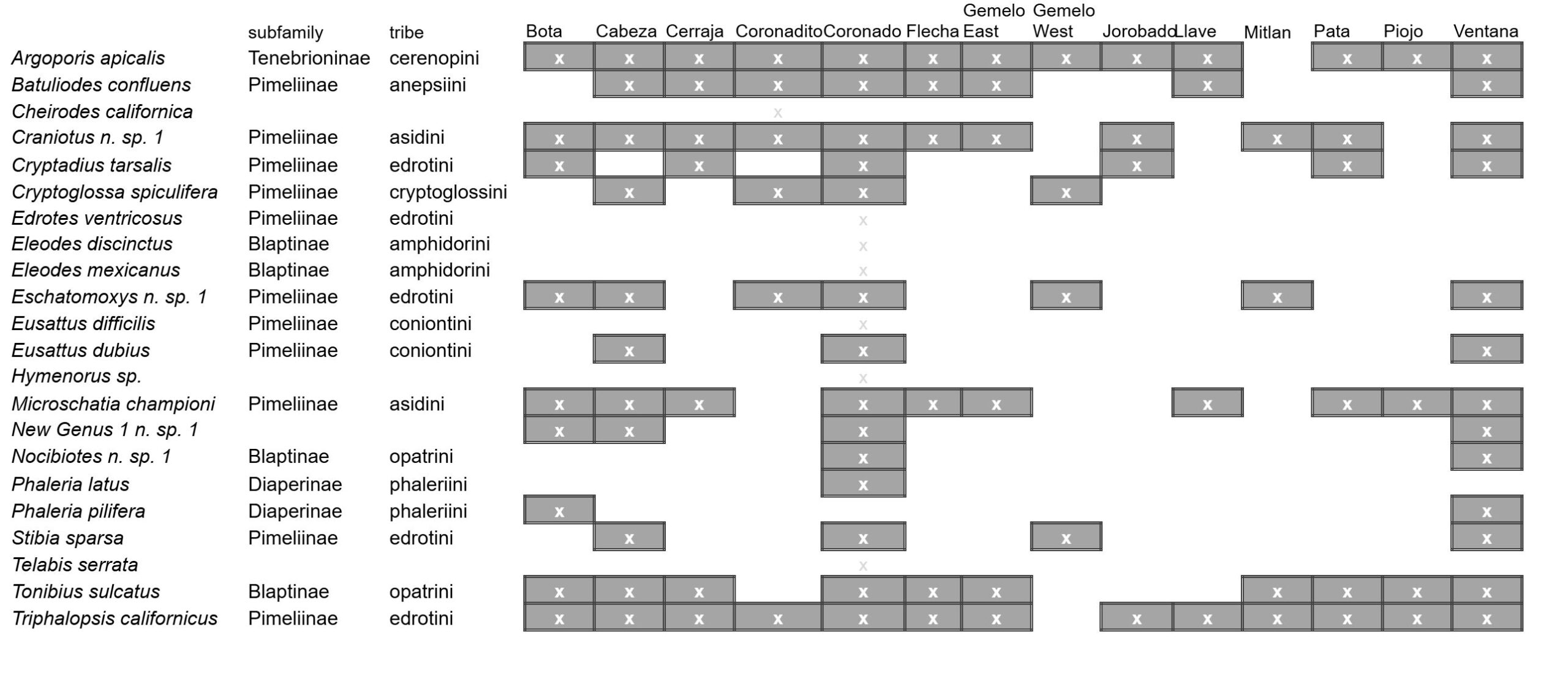
    Distribution of each species are based on data from Sanchez Piñero and Aalbu (2002). A table extracted from their observations can be found here.

    Click the photographs if you want to see larger versions.

    Argoporis apicalis

    Medium sized, with ridged elytra and reddish legs. Argoporis is one of the few Tenebrionids on the islands which possess defensive glands in their abdomens.

    Found on all islands except Mitlan (tiny island next to Coronado).

    12 mm
    narrow black beetle with reddish legs held by fingers
    Argoporis apicalis trapped on Coronadito island. 6/26/25.
    Argoporis apicalis trapped on Cerraja island. The blurred image of an extra antenna was caused by using focus stacking to improve depth of field. 6/27/25.

    Batuliodes confluens

    This tiny brown beetle with roughened pronotum and elytra.

    Found on the majority of islands, and may be undercounted due to its small size.

    tiny black beetle on a white background
    ~3 mm
    Batuliodes confluens trapped on Flecha island. 6/23/14
    Batuliodes confluens trapped on Cerraja island. 6/27/25.

    Cryptadius tarsalis

    Small, oval, and deep-bodied, with dense rows of small punctures on the elytra.

    Cryptadius is found on Bota, Cerraja, Coronado, Jorobado, Mitlan and Pata.

    Diagram of a small beetle on a white background
    8 mm
    Cryptadius tarsalis.trapped on Llave island. Scale bar, 2 mm. 6/27/25

    Cryptoglossa spiculifera

    One of the largest beetles on the islands, with elytra decorated with rows of raised, spiny bumps.

    Found on the largest islands (Coronado, Cabeza de Caballo, but not La Ventana) as well as the rookery island, Gemelos West.

    diagram of a black beetle  almost filling a white background.
    28 mm
    Cryptoglossa spiculifera trapped on Gemelos West island, 6/28/25.
    Large black beetle on blurred blue background.
    Cryptoglossa spiculifera trapped on Gemelos West island. Scale bar, 10 mm. 6/28/25.

    Microschatia championi

    Slightly smaller than Cryptoglossa, the elytra of Micoschatia are decorated with dimples rather than sharp bumps and there are punctures on the lateral pronotum of M. championi.

    Present on all but the smallest islands.

    20 mm
    Microschatia championi trapped on Cerraja island. 6/27/25.
    Microschatia championi trapped on Cerraja island. Scale bar, 5 mm. 6/27/25.

    Stibia sparsa

    Shaped like a typical Tenebrionid, with dense punctures on the pronotum and rows of punctures on the elytra.

    Stibia can be found on the largest islands (Cabeza de Caballo, Coronado, La Ventana) plus Gemelos West.

    diagram of a black beetle on a large white background
    11 mm
    small brownish black beetle held in fingers
    Stibia sparsa trapped on Gemelos West island. 6/28/25
    dorsal view of black beetle on blurred blue background
    Stibia sparsa trapped on Gemelos West island. Scale bar, 2 mm. 6/28/25.

    Tonibius sulcatus

    Very small and reddish, with relatively smooth pronotum and strongly ridged elytra.

    Described from most islands, except Coronaditio, Gemelos West, Jorobado and Llave.

    diagram of a very small black beetle on a white background
    6 mm
    Tonibius sulcatus found at Las Hamacas hotel. 7/10/24.

    Triphalopsis californicus

    Small, black, oval, and deep-bodied. Covered with fine hairs that are often coated in dust.

    Triphalopsis has been described from all islands except Gemelo West.

    Diagram of a small beetle on a white background
    8 mm
    Triphalopsis californicus trapped on Flecha island. 6/27/25.
    Triphalopsis californicus trapped on Cerraja island. Scale bar, 2 mm. 6/27/25.

    There are many other beetles, including various species of Histeridae and Dermestidae (not shown).

    Hister Beetle on Coronadito Island. Scale 2 mm. 6/26/25.

    Centipedes, spiders, and scorpions are often found in the traps in the larger islands.

    Scorpion trapped on La Ventana. 6/28/25

    References

    Sanchez Piñero, F. and Aalbu, R. L. (2002). Tenebrionid Beetles (Appendix 6.1). In A New Island Biogeography of the Sea of Cortés, pp. 129–153. New York: Oxford University Press.