The islands in the Gulf of California provide a natural laboratory for the effects of “spatial subsidy,” the movement of resources from a rich environment (the sea) to a more impoverished habitat (the desert islands). In this context, scientists have studied many species on the islands, including Tenebrionid beetles. The abundance and diversity of beetles on the islands of Bahia de los Angeles have been surveyed for at least 30 years, and my good friend and colleague Dr Drew Talley has been leading the studies for most of that time. In recent years, Dr Natalia Rodriguez Revelo, an expert in beetles and dune ecology, has participated in the work with Drew. I have participated in various roles for several of the past 20 field seasons, and was once again privileged to spend time with them and help out on the islands this year.

The procedure is straightforward in principle: on each island, set multiple pitfall traps (plastic party cups) baited with lean pieces of fish. The beetles (and, occasionally, other creatures) fall into the traps. Six days later, the traps are checked and the number and species of beetles are scored. In practice, mice or gulls can steal bait if it is not adequately secured, or fat from fish guts can turn the contents of the cup to smelly soup.
In a perfect world, traps would be set on all of the accessible islands in the bay. In practice, time constraints forced us to prioritize. This year, we sampled Coronadito, Coronado (also known as Isla Smith), Flecha, Pata, Llave, Cerraja, La Ventana, Cabeza de Caballo, and Gemelos West.
I made an effort this year to photograph each species using a platform with tacky wax to secure the beetle, and a scale to document its size.

It was marginally successful, and provided insight about how to improve future versions.
Below is a draft guide to the beetles found on the islands, When possible, photos are provided of beetles held in fingers and mounted on the photography platform. Cartoons provide graphic representation of the relative sizes of the beetles, ranging from tiny (Batuliodes) to hefty (Cryptoglossa), keeping in mind that the sizes of all species can vary significantly.
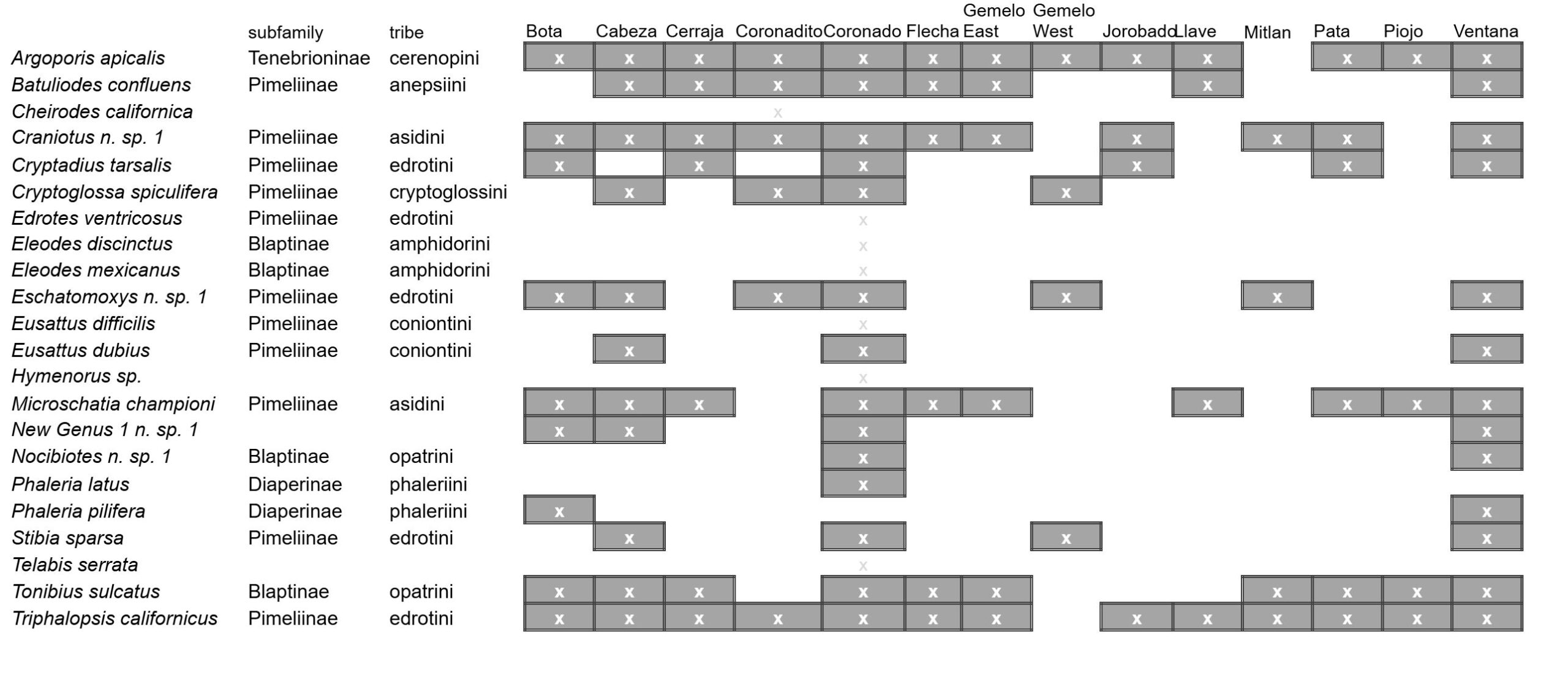
Distribution of each species are based on data from Sanchez Piñero and Aalbu (2002). A table extracted from their observations can be found here.
Click the photographs if you want to see larger versions.
Argoporis apicalis
Medium sized, with ridged elytra and reddish legs. Argoporis is one of the few Tenebrionids on the islands which possess defensive glands in their abdomens.
Found on all islands except Mitlan (tiny island next to Coronado).


Batuliodes confluens
This tiny brown beetle with roughened pronotum and elytra.
Found on the majority of islands, and may be undercounted due to its small size.


Cryptadius tarsalis
Small, oval, and deep-bodied, with dense rows of small punctures on the elytra.
Cryptadius is found on Bota, Cerraja, Coronado, Jorobado, Mitlan and Pata.


Cryptoglossa spiculifera
One of the largest beetles on the islands, with elytra decorated with rows of raised, spiny bumps.
Found on the largest islands (Coronado, Cabeza de Caballo, but not La Ventana) as well as the rookery island, Gemelos West.


Microschatia championi
Slightly smaller than Cryptoglossa, the elytra of Micoschatia are decorated with dimples rather than sharp bumps and there are punctures on the lateral pronotum of M. championi.
Present on all but the smallest islands.


Stibia sparsa
Shaped like a typical Tenebrionid, with dense punctures on the pronotum and rows of punctures on the elytra.
Stibia can be found on the largest islands (Cabeza de Caballo, Coronado, La Ventana) plus Gemelos West.


Tonibius sulcatus
Very small and reddish, with relatively smooth pronotum and strongly ridged elytra.
Described from most islands, except Coronaditio, Gemelos West, Jorobado and Llave.


Triphalopsis californicus
Small, black, oval, and deep-bodied. Covered with fine hairs that are often coated in dust.
Triphalopsis has been described from all islands except Gemelo West.


There are many other beetles, including various species of Histeridae and Dermestidae (not shown).

Centipedes, spiders, and scorpions are often found in the traps in the larger islands.

References
Sanchez Piñero, F. and Aalbu, R. L. (2002). Tenebrionid Beetles (Appendix 6.1). In A New Island Biogeography of the Sea of Cortés, pp. 129–153. New York: Oxford University Press.